

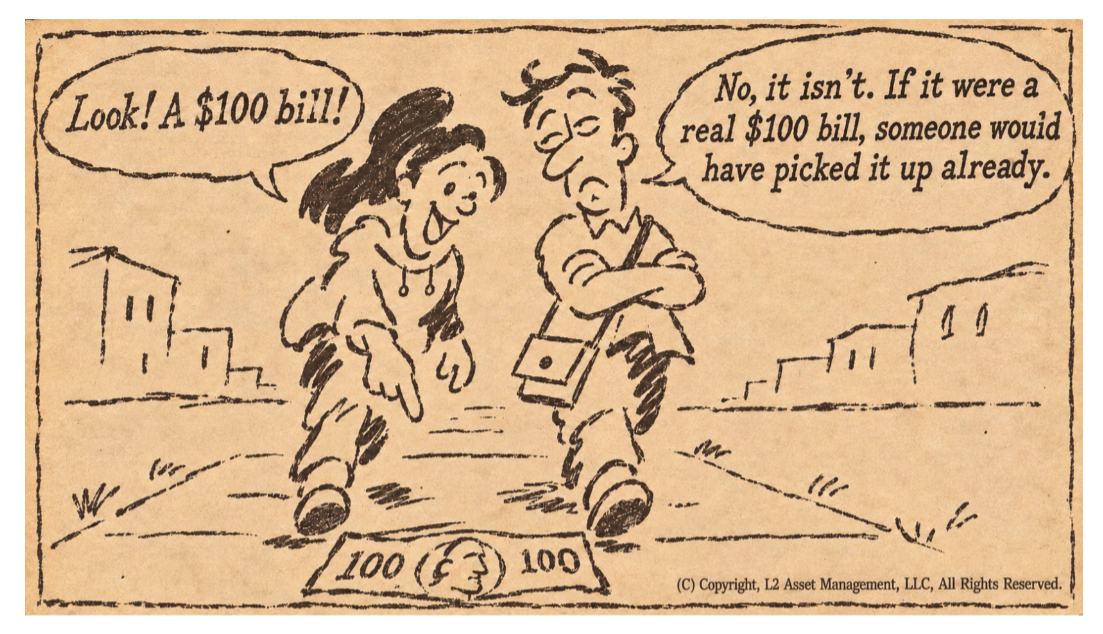
In the old joke, an economist walks past a $100 bill on the sidewalk. It cannot be real, he explains. Someone would have picked it up already.
Excellent theory. Expensive walk.
Andrei Shleifer devoted Inefficient Markets to explaining why investors leave money on the pavement—and sometimes pay extraordinary prices for rubbish.
We manage an index fund. We believe cheap beta belongs in an Advisor’s toolkit. We also believe the price of a business matters.
Our recent research offers five reasons to keep looking down.
Get our insights direct to your inbox: SUBSCRIBE
1. Your diversification has a concentration problem
- Thirty stocks. Forty-eight percent of the U.S. market. That is a lot of eggs for a supposedly broad basket.
- Those stocks command 6.2x sales, versus 5.0x at the dot-com peak.
- Their cash-flow yield after stock-based compensation is about one-third that of the other 470 S&P stocks.
- Investors are paying more for the privilege of collecting less.

2. Losing money has become remarkably expensive
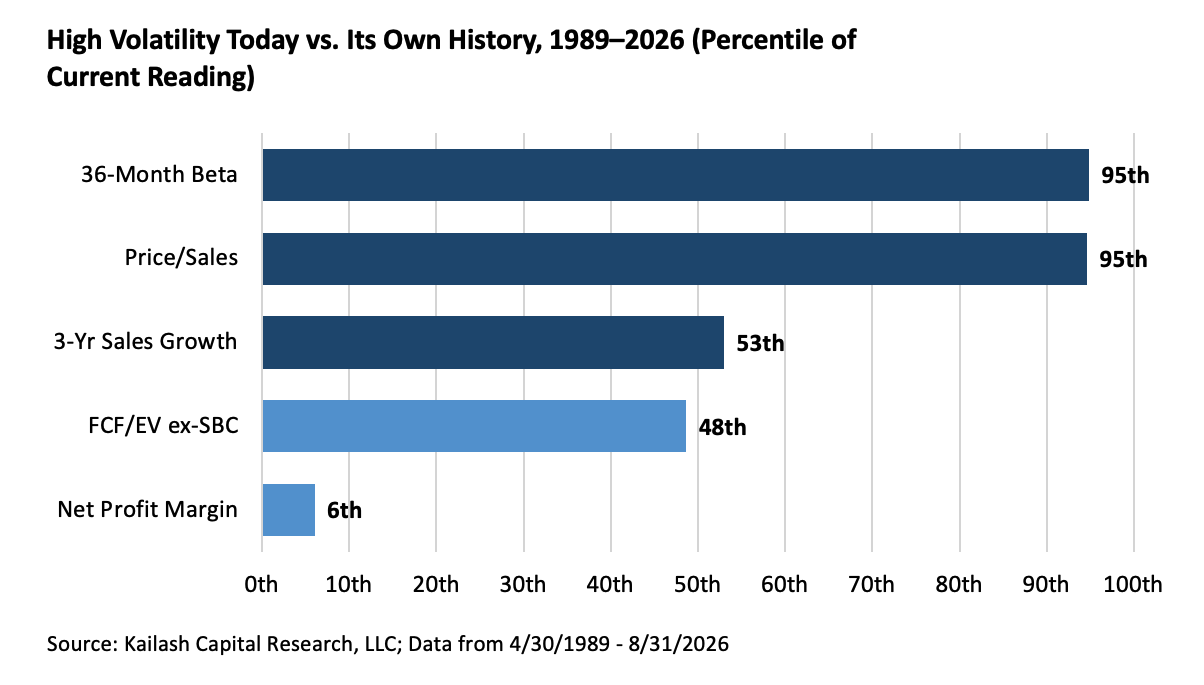
- The most volatile fifth of stocks in our universe has an equal-weighted net margin of −371%.
- Investors pay 5.2x sales to own the group.
- Analysts pencil in 54% annual earnings growth. Even dot-com analysts expected less.
- Short interest has collapsed to a 23‑year low. These companies have found something scarcer than profits: skeptics willing to bet against them.
3. AI has discovered a new funding source called everyone else
- Our IBM case study shows customers postponing software and mainframe deals to rush hardware purchases. IBM’s shares fell 25% in a day.
- The market rewarded Sandisk, Western Digital and Seagate with sales multiples that more than doubled across our April and July comparisons.
- The study cited in our paper found 95% of enterprise GenAI pilots had no measurable profit impact.
- Some of the orders may be tomorrow’s purchases arriving early. The valuations assume the party keeps growing.

4. The index is getting harder for its own members to recognize
- 138 of 498 S&P 500 stocks had negative six-month betas on September 30. That is 27.7%.
- The previous record was 17.3% in the dot-com bust.
- The median constituent’s beta fell to 0.42, a 37-year low.
- A few giants increasingly define “the market.” Hundreds of other businesses apparently missed the meeting.

5. The giants charge a cover fee that midcaps do not
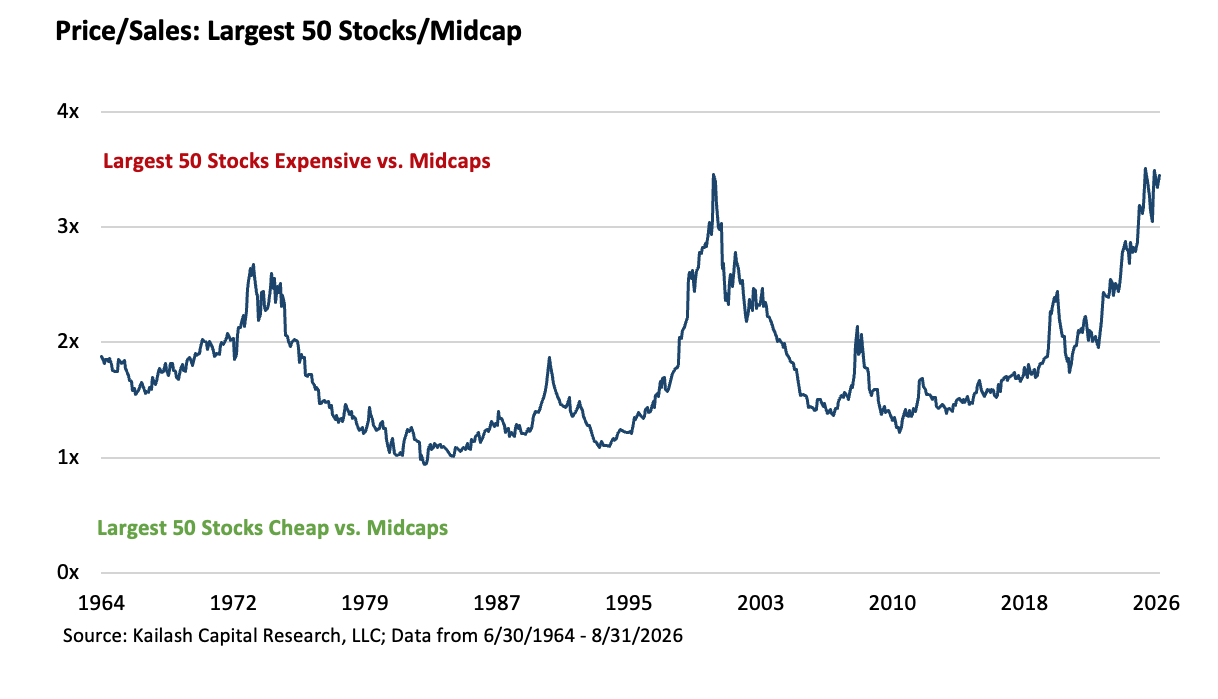
- The largest 50 stocks trade at 3.5 times midcaps’ sales multiple. The dot-com peak offers the same uncomfortable comparison.
- Midcaps’ share of the Russell 1000 has fallen to 19.4%, against a historical average of 30.2%.
- Their long record includes outperforming in 68% of rolling ten-year periods.
- Investors have rarely owned less of them. Paying attention to that gap requires more patience than joining the crowd.
Summary: Pick Up the $100 Bill?
- Concentration is doing a convincing impersonation of diversification. Thirty stocks account for nearly half the U.S. market. The other 470 S&P stocks offer roughly three times the cash-flow yield after stock-based compensation. The biggest names come with a very expensive cover charge.
- Investors have developed expensive tastes in money losers. The most volatile stocks combine steep valuations, deep losses and heroic growth expectations. Less volatile, profitable businesses attract considerably less excitement. We think the boring guests deserve a closer look.
- AI’s shopping spree has been priced like a permanent holiday. Budgets are being raided, orders pulled forward and valuations marked up. Investors paying those prices had better hope the spending produces profits before the bill arrives.
- “Own the market” increasingly means “follow the giants.” The S&P 500’s dominant stocks are steering the benchmark while an unprecedented share of its constituents has negative recent beta. Advisors should know how much concentration comes with that inexpensive wrapper.
- Midcaps remain outside the velvet rope. Their valuation discount to the giants rivals the dot-com extreme, despite a strong long-term record. The opportunity deserves attention—and the wait requires patience.
A low fee is worth having. A sensible purchase price is worth checking. We believe Advisors can care about both—and still bend down when they spot the $100 bill.
This message brought to you by the folks who believe in People, Process, Performance®, know that Life’s Bills Don’t Always Come at Market Tops®, know We’re In the Moneyball Business, Not the Crystal Ball Business®, and strive to deliver Active Management At Passive Prices.®
Disclaimer
The information, data, analyses, and opinions presented herein (a) do not constitute investment advice, (b) are provided solely for informational purposes and therefore are not, individually or collectively, an offer to buy or sell a security, (c) are not warranted to be correct, complete or accurate, and (d) are subject to change without notice. Kailash Capital Research, LLC and its affiliates (collectively, “KCR”) shall not be responsible for any trading decisions, damages, or other losses resulting from, or related to, the information, data, analyses or opinions or their use. The information herein may not be reproduced or retransmitted in any manner without the prior written consent of KCR. In preparing the information, data, analyses, and opinions presented herein, KCR has obtained data, statistics, and information from sources it believes to be reliable. KCR, however, does not perform an audit or seek independent verification of any of the data, statistics, and information it receives. KCR and its affiliates do not provide tax, legal, or accounting advice. This material has been prepared for informational purposes only and is not intended to provide, and should not be relied on for tax, legal, or accounting advice. You should consult your tax, legal, and accounting advisors before engaging in any transaction.
Nothing herein shall limit or restrict the right of affiliates of KCR to perform investment management or advisory services for any other persons or entities. Furthermore, nothing herein shall limit or restrict affiliates of KCR from buying, selling, or trading securities or other investments for their own accounts or for the accounts of their clients. Affiliates of KCR may at any time have, acquire, increase, decrease, or dispose of the securities or other investments referenced in this publication. KCR shall have no obligation to recommend securities or investments in this publication as a result of its affiliates’ investment activities for their own accounts or for the accounts of their clients.
© 2026 Kailash Capital Research, LLC – All rights reserved.
November 20, 2026 |
| Authors: Matthew Malgari, Nathan Przybylo, Dr. Sanjeev Bhojraj and John Durkin
November 20, 2026
Authors: Matthew Malgari, Nathan Przybylo, Dr. Sanjeev Bhojraj and John Durkin
