

An Attractive Valuation vs. a Patent Cliff & the Role of AI in Human Welfare
Bristol Myers Squibb (BMY), one of the largest biopharmaceutical companies in the world, develops, manufactures, and markets prescription drugs focused on oncology, hematology, immunology, cardiovascular disease, and neuroscience. BMY is currently confronting a significant challenge: Can the company replace its aging blockbuster drugs with new drugs that have high growth potential before patent protections on those legacy products expire, dragging down revenues and earnings?
Pharmaceutical companies face this “patent cliff” problem from time to time. One question investors are focused on is whether or not new drugs BMY has recently acquired or is developing will be approved before the patents on existing blockbusters expire. This article makes the case that the pessimism around BMY’s stock, which is trading at less than 10x earnings due to perceived risk from its patent cliff, may have created a margin of safety for long-term investors.
Why We Are Bullish on BMY:
- An expanding portfolio of drugs with high growth opportunities. BMY has made good progress in replacing its portfolio of legacy drugs to counter the patent-cliff threat. Its growth portfolio (which BMY has specified as a group of new drugs with significant upside) already contributes over half of total revenues with several drugs showing strong momentum.
- …yet valuation multiples suggest the growth story has yet to be recognized by investors. The patent cliff narrative appears to be dominating BMY’s stock, with insufficient credit given to the growth portfolio. This suggests an opportunity to establish a position at a very attractive price.
- Legacy products are still contributing. For example, BMY’s blood thinner Eliquis (one of the highest-grossing small-molecule prescription drugs globally) is approaching its U.S. patent expiration date, but patent protections based on various settlements in certain markets will extend 6 to 18 months beyond that. Q2 2026 sales were up 22%, and BMY raised its full-year 2026 growth forecast for Eliquis to 20%-25%.i
- Emphasis on AI-driven innovation. The company is using an AI-based “Predict First” approach to more accurately identify viable drug candidates. It expects this will speed development, improve clinical trials, and reduce costs – a real-world example of what KCR sees as one of the most powerful use-cases for AI to advance human welfare.
- Leveraging AI to analyze vast patient data sets. As another clear value-added AI use case, BMY plans to use AI to refine clinical trial designs, with expectations of reducing average clinical trial timelines by up to three years and reduce toxicology study times by ~25%.ii McKinsey estimates AI could generate productivity gains in the pharmaceutical industry of 35%-45% over the next five years.iii
While several of the AI frontier model providers appear to be headed for valuations north of a trillion dollars despite a commitment to burn trillions in investors’ cash while offering a highly uncertain ROI, we find it remarkable that a life sciences company deploying concrete revenue-generating and cost-saving AI use-cases is trading at 10x earnings with nearly a 7% FCF Yield.
What is the Bear Case?
The patent cliff is growing closer. The legacy portfolio is shrinking and some of the new products BMY recently acquired are relatively small and will need years of rapid growth to compensate for the revenue loss that will occur as the blockbusters go “off the cliff”. While some of the newly-acquired drugs are in Phase 3 clinical trials they could still fail to win FDA approval. Thus, the key concern is, can BMY achieve growth through the new products it has acquired quickly enough?
For more details, please continue reading.
Get our insights direct to your inbox: SUBSCRIBE
Investment Summary
Bristol Myers Squibb (BMY) researches, develops, manufactures, and markets prescription drugs globally, focusing largely on treatments used in oncology, hematology, immunology, cardiovascular disease, and neuroscience. BMY competes with industry giants such as Johnson & Johnson, Merck, Roche, Eli Lilly, and Pfizer, all of whom typically make chemically-based “small molecule” drugs, but biotech firms, which use living organisms to make medicines, are also part of the picture. Over time, the distinction between the two has blurred as big pharma has been investing in biotech.iv BMY is headquartered in New Jersey, with its roots dating back to the mid-late 1800s.
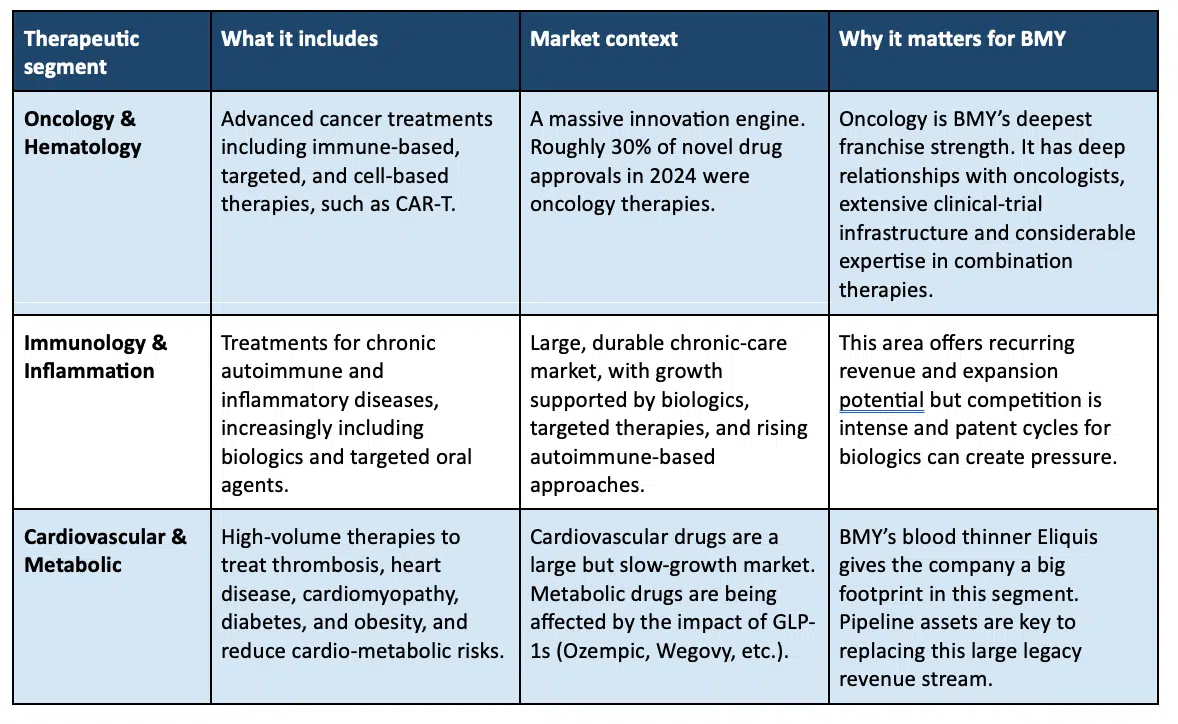
In our view, BMY’s areas of expertise are well diversified with large potential markets. Pharmaceutical and biopharmaceutical companies often specialize in terms of therapeutic focus. BMY’s expertise is in oncology/hematology, immunology and inflammation, and cardiovascular and metabolic disease.
BMY’s Key Customer Segments
A pharmaceutical company’s customers are segmented into the entities that buy the product, the physicians who prescribe it, and the payers who influences access to it (private insurers, Medicare, and Medicaid). This requires a range of marketing efforts.

BMY’s portfolio is reasonably diversified by end market, but oncology and hematology are especially important. That means the company is not dependent on a single medical specialty but is exposed to dynamics in the specialty-care arena. Its reputation among physicians is a critical asset to protect.
While pharmaceutical and biopharma companies do compete with each other, our analysis is not about BMY’s position versus its industry competitors but on its patent cliff and how it is responding to that challenge. Securing the next generation of patented assets is far more important than fighting for incremental market share.
Facing the “patent cliff” – why BMY is interesting right now
The pharmaceutical industry’s “patent cliff” challenge is well known. When patents on a blockbuster drug expire, generic versions come to market quickly, pushing prices down significantly. Prices for small-molecule drugs often drop by one-third in the first year after expiration and by more than 80% within eight years.vi The company that owns the patent lowers its own prices to retain at least some market share, but revenue and profits take a significant hit. Thus, pharma companies like BMY seek to internally develop or acquire new products in time to replace what they will lose when patents on their legacy drugs expire. Note that it takes years to develop a new drug, and 90% of discovery efforts fail in the lab, never making it to a clinical trial.vii
BMY is on the edge of more than one patent cliff, as protection for two of its blockbuster drugs—blood-thinner Eliquis and Opdivo, a cancer immunotherapy—which together represent roughly 50% of its revenues, will expire between 2026 and 2028.viii Management has been cutting costs to help offset the immediate blow but is primarily focused on renewing its growth portfolio. As developing new drugs internally would take too long (it takes a decade to go from idea to commercialization), BMY is primarily relying on acquisitions to create a new drug pipeline that will provide growth and stabilize cash flows.
How should investors analyze this? In our view,


Disclaimer
The information, data, analyses, and opinions presented herein (a) do not constitute investment advice, (b) are provided solely for informational purposes and therefore are not, individually or collectively, an offer to buy or sell a security, (c) are not warranted to be correct, complete or accurate, and (d) are subject to change without notice. Kailash Capital Research, LLC and its affiliates (collectively, “KCR”) shall not be responsible for any trading decisions, damages, or other losses resulting from, or related to, the information, data, analyses or opinions or their use. The information herein may not be reproduced or retransmitted in any manner without the prior written consent of KCR. In preparing the information, data, analyses, and opinions presented herein, KCR has obtained data, statistics, and information from sources it believes to be reliable. KCR, however, does not perform an audit or seek independent verification of any of the data, statistics, and information it receives. KCR and its affiliates do not provide tax, legal, or accounting advice. This material has been prepared for informational purposes only and is not intended to provide, and should not be relied on for tax, legal, or accounting advice. You should consult your tax, legal, and accounting advisors before engaging in any transaction.
Nothing herein shall limit or restrict the right of affiliates of KCR to perform investment management or advisory services for any other persons or entities. Furthermore, nothing herein shall limit or restrict affiliates of KCR from buying, selling, or trading securities or other investments for their own accounts or for the accounts of their clients. Affiliates of KCR may at any time have, acquire, increase, decrease, or dispose of the securities or other investments referenced in this publication. KCR shall have no obligation to recommend securities or investments in this publication as a result of its affiliates’ investment activities for their own accounts or for the accounts of their clients.
© 2026 Kailash Capital Research, LLC – All rights reserved.
October 30, 2026 |
| Authors: Matthew Malgari, Nathan Przybylo, Dr. Sanjeev Bhojraj and John Durkin
October 30, 2026
Authors: Matthew Malgari, Nathan Przybylo, Dr. Sanjeev Bhojraj and John Durkin
