

One of the largest oilfield service providers in the world, Halliburton Company (HAL) is widely regarded as the largest hydraulic fracturing, or fracking, and pressure pumping provider in North America. Fracking is the process of injecting liquid and proppants like sand at high pressure to create small fractures within tight shale formations that let oil or gas flow freely from an underground well. Pressure pumping is the core mechanical process of fracking whereby gigantic surface pumps force fluid deep underground at very high pressures to crack rock formations.
Get our insights direct to your inbox: SUBSCRIBE
Why We Are Bullish on HAL:
- HAL’s leading position in the energy industry, a group to which many investors do not have nearly enough exposure, along with improving fundamentals and an undemanding valuation, make the stock a compelling investment opportunity.
- Investors seem to be valuing HAL based on the assumption that its operating margins (currently around 13%, down from 17%+ in 2023 and 2024) will decline further even though the demand for its services looks to be rising both in North America and internationally. Based on consensus 2026 EPS estimates and trailing twelve-months EBITDA, HAL trades at a P/E of only 15.3x and an enterprise value (EV)-to-EBITDA multiple of just 8.5x, marked discounts to both peer oilfield service companies and the overall stock market. Each one multiple point improvement in HAL’s P/E or EV-to-EBITDA ratios would translate into $2.50 or $5.00 boosts, respectively, to its share price.
- HAL has a balanced portfolio that spans North America and international, onshore and offshore, and mature and new plays. Its time-tested operating excellence and reputation allow it to expand into even more diverse geographic markets. Importantly, the company is gaining market share in international markets. Indeed, HAL expects international revenue may reach around $16 billion in 2028, up from $13.4 billion over the twelve months ended June 30, 2026 and $10.7 billion in 2022. If this $2.5 to $3 billion of incremental revenue were to carry an average 15% operating margin, that extra business could produce ~$0.40 of additional earnings per share for HAL.
- HAL is a predictable generator of enormous free cash flow. The company has consistently dedicated much of this excess cash flow — which has averaged $2.1 billion annually, or ~$2.50 per share, over the last four years — to buy back its own shares.
- The stock market is ascribing little value to HAL’s potentially booking substantial future revenue and profits in Venezuela from the U.S. Administration’s recently announced oil deal there. As a “provider of picks and shovels,” HAL promises to be among the biggest beneficiaries if this transaction progresses to reality. As recently as 2015, HAL booked ~$500 million of annual Venezuela-related revenue.
What is the Bear Case? Like many energy companies, HAL would be impacted by a downturn — particularly an unexpected one — in oil prices. However, the impact of the Middle East war is more far-reaching than investors have so far been willing to acknowledge. Indeed, total lost oil supply has reached 2.6 billion barrels, the largest cumulative oil supply disruption since the 1979 Iranian revolution. In turn, energy industry executives and government officials will be forced to rebuild inventories, refill reserves, and diversify energy supplies. Furthermore, such a replenishment effort will likely be measured in years, not quarters.
Investment Summary
One of the largest oilfield service providers in the world, Halliburton Company (HAL) is widely regarded as the largest hydraulic fracturing, or fracking, and pressure pumping provider in North America. Fracking is the process of injecting liquid and solid proppants like sand at high pressure to create small fractures within tight shale formations that let oil or gas flow freely from an underground well. Pressure pumping is the core mechanical process of fracking whereby gigantic surface pumps force fluid deep underground at very high pressures to crack rock formations. Constructively for HAL, pressure pumping capacity is tightening in North America as prolonged underinvestment in pressure pumping equipment has translated into natural fleet attrition and the cannibalization of older equipment for spare parts. In turn, any idle pressure pumping capacity is being steadily absorbed (i.e., used) into the market.1 This ongoing market transition is allowing HAL to shift its focus from increasing equipment utilization to increasing prices (and margin expansion).
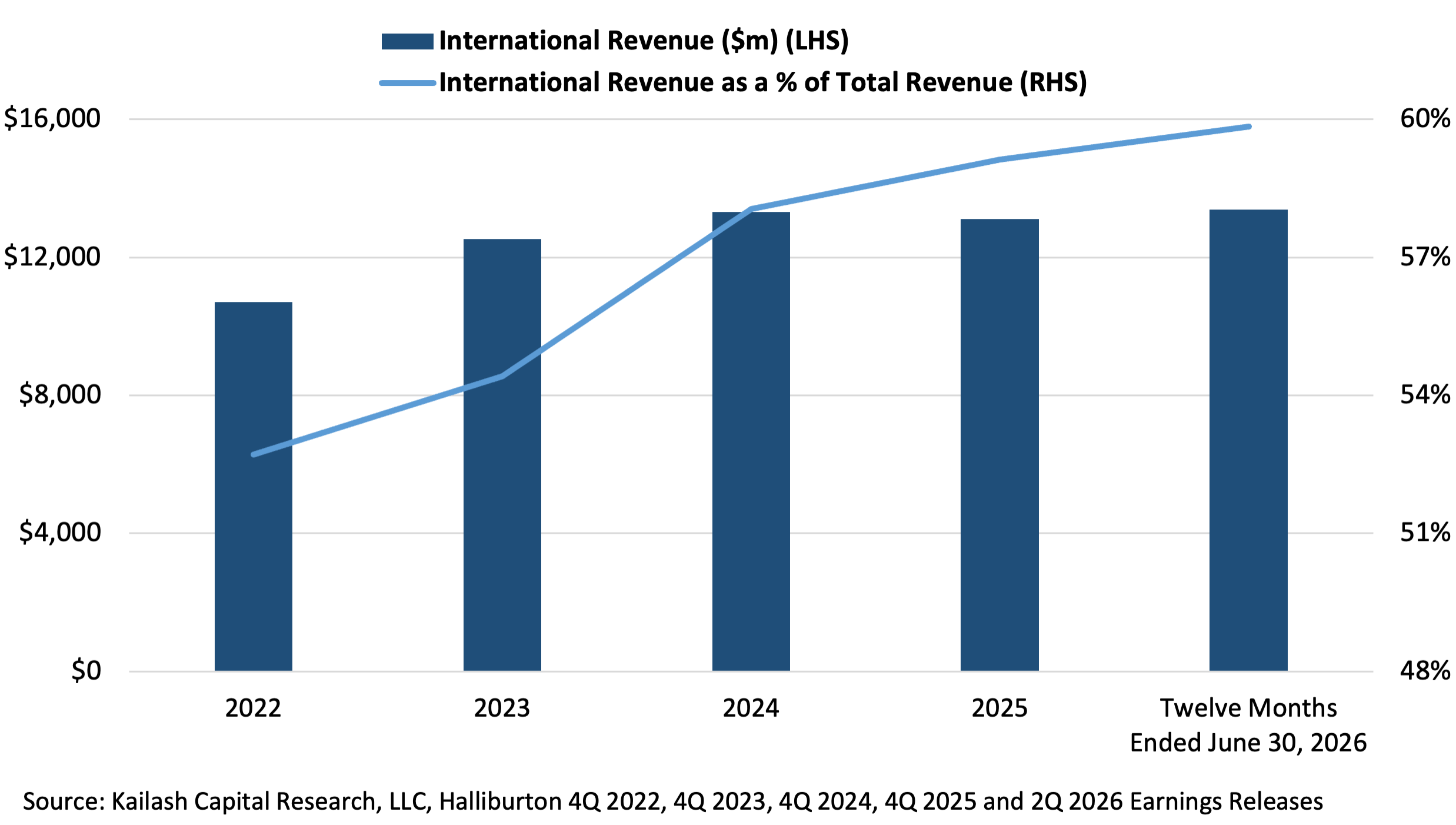
HAL has a balanced portfolio that spans North America and international, onshore and offshore, and mature and new plays.2 Its time-tested operating excellence and reputation allow it to expand into even more diverse geographic markets. Phrased differently, based on recent award announcements, HAL is gaining market share in international markets. More specifically, HAL expects international revenue may reach around $16 billion in 2028,3 up from $13.4 billion over the twelve months ended June 30, 2026 and $10.7 billion in 2022. If this $2.5 to $3 billion of incremental revenue were to carry an average 15% operating margin, that extra business could produce ~$0.40 of additional earnings per share for HAL.
Halliburton Company’s International Revenue is Growing Both in Dollar Terms and as a Percentage of Total Revenue
More broadly from a valuation perspective, investors seem to be valuing HAL based on the assumption that its operating margins (currently around 13%, down from 17%+ in 2023 and 2024) will decline further even though the demand for its services looks to be rising both in North America and internationally. Based on consensus 2026 EPS estimates and trailing twelve-months EBITDA, HAL trades at a P/E of only 15.3x and an enterprise value (EV)-to-EBITDA multiple of just 8.5x, marked discounts to both peer oilfield service companies and the overall stock market. Each one multiple point improvement in HAL’s P/E or EV-to-EBITDA ratios would translate into about $2.50 or $5.00 boosts, respectively, to its share price. In our view, HAL’s leading position in the energy industry, a group to which many investors do not have nearly enough exposure, along with improving fundamentals and an undemanding valuation, make the stock a compelling investment opportunity.
HAL is a predictable generator of enormous free cash flow. The company has consistently dedicated much of this excess cash flow — which has averaged $2.1 billion annually, or ~$2.50 per share, over the last four years — to buy back its own shares. (Furthermore, unlike many companies which repurchase significant quantities of their own shares, HAL’s share count has actually declined because it records no appreciable share-based compensation. HAL’s shares outstanding have been sliced 6.5% over the last 2 ½ years to 833.1 million as of mid-July 2026 from 890.1 million in late January 2024.)4

In addition, investors are ascribing little value to HAL’s potentially booking substantial future revenue and profits in Venezuela from the U.S. Administration’s recently announced oil deal there. (More on that later). As a “provider of picks and shovels,” HAL promises to be among the biggest beneficiaries if this transaction progresses to reality. As recently as 2015, HAL booked ~$500 million of annual Venezuela-related revenue.5
Company Description
HAL is fundamentally — and historically — correlated with the number of active rigs in the Permian Basin; however, the degree of correlation is not as high as it once was. Indeed, a higher active rig count creates direct demand for both of HAL’s high-margin segments: Drilling & Evaluation and Completion & Production (fracking, cementing, and well-boring workflow). However, efficiency gains blur the one-to-one linkage between active rig count data and HAL’s financial performance. Drilling horizontally for miles and autonomous fracking technology (while using, say, HAL’s ZEUSÒ fleets; see just below) can allow operators to expand production even while lowering total rig counts. Importantly, such horizontal drilling can likewise allow HAL to generate higher revenue even when rig counts are flat to slightly down. Similarly, if operators draw down their inventory of drilled but uncompleted wells, or DUCs (see pages 10-11), HAL’s revenue and earnings can remain strong if the number of active rigs declines.
In greater detail, HAL holds the largest market share in the giant North American oilfield services industry.6 More specifically, the company is considered the industry leader in two key areas:
- Well stimulation, an operation which enhances production in shale rock formations or restores flow from a given well that has been reduced due to debris or formation damage around the well that builds up over time. Fracking and acidizing, or the injection of chemicals or acids at low pressure to clear blockages near the wellbore,7 are the two main elements of a well stimulation process. HAL produces drilling fluids (commonly known as drilling mud) like nonaqueous fluids and synthetic-based mud that can be customized to various well environments.
Notably, HAL’s ZEUSÒ integrated, all-electric, 5,000-hydraulic horsepower (HHP) frack site is not only quite efficient, but cuts greenhouse emissions and fuel costs. The giant ZEUSÒ platform, which is a closed loop system that monitors and fixes operational issues without human assistance, dramatically reduces the physical footprint at a wellsite versus legacy systems. In addition, HAL’s OCTIVÒ digital fracturing services eliminates fracture execution variability under multiple well conditions and allows remote connectivity across all aspects of its fracking business.8

- HAL is expert in well cementing, the process of pumping liquid cement slurry into the space between a drilled hole and the steel pipe which cases the well. The company’s iCemÒ digital 3D cementing modeling software optimizes these operations and prevents gas migrations or fluids from leaking between different geological layers. (HAL’s founder patented the foundational process of well cementing more than a century ago.9)
The table below is a brief summary of HAL’s position vis-à-vis competitors like SLB N.V. (formerly known as Schlumberger) and Baker Hughes Company in major tasks performed by oilfield services companies. A good summary of the data below is the following statement: “While SLB is the global leader in the oilfield services industry in reservoir valuation, HAL is the leader in any activity from the reservoir to the wellbore.”10

The Expanding Middle East War Has Changed the Oil and Gas World
The tone of the global oil markets have changed dramatically since 2025. Last year, commodity prices and U.S. and international rig counts


Disclaimer
The information, data, analyses, and opinions presented herein (a) do not constitute investment advice, (b) are provided solely for informational purposes and therefore are not, individually or collectively, an offer to buy or sell a security, (c) are not warranted to be correct, complete or accurate, and (d) are subject to change without notice. Kailash Capital Research, LLC and its affiliates (collectively, “KCR”) shall not be responsible for any trading decisions, damages, or other losses resulting from, or related to, the information, data, analyses or opinions or their use. The information herein may not be reproduced or retransmitted in any manner without the prior written consent of KCR. In preparing the information, data, analyses, and opinions presented herein, KCR has obtained data, statistics, and information from sources it believes to be reliable. KCR, however, does not perform an audit or seek independent verification of any of the data, statistics, and information it receives. KCR and its affiliates do not provide tax, legal, or accounting advice. This material has been prepared for informational purposes only and is not intended to provide, and should not be relied on for tax, legal, or accounting advice. You should consult your tax, legal, and accounting advisors before engaging in any transaction.
Nothing herein shall limit or restrict the right of affiliates of KCR to perform investment management or advisory services for any other persons or entities. Furthermore, nothing herein shall limit or restrict affiliates of KCR from buying, selling, or trading securities or other investments for their own accounts or for the accounts of their clients. Affiliates of KCR may at any time have, acquire, increase, decrease, or dispose of the securities or other investments referenced in this publication. KCR shall have no obligation to recommend securities or investments in this publication as a result of its affiliates’ investment activities for their own accounts or for the accounts of their clients.
© 2026 Kailash Capital Research, LLC – All rights reserved.
September 25, 2026 |
| Authors: Matthew Malgari, Nathan Przybylo, Dr. Sanjeev Bhojraj and John Durkin
September 25, 2026
Authors: Matthew Malgari, Nathan Przybylo, Dr. Sanjeev Bhojraj and John Durkin
