

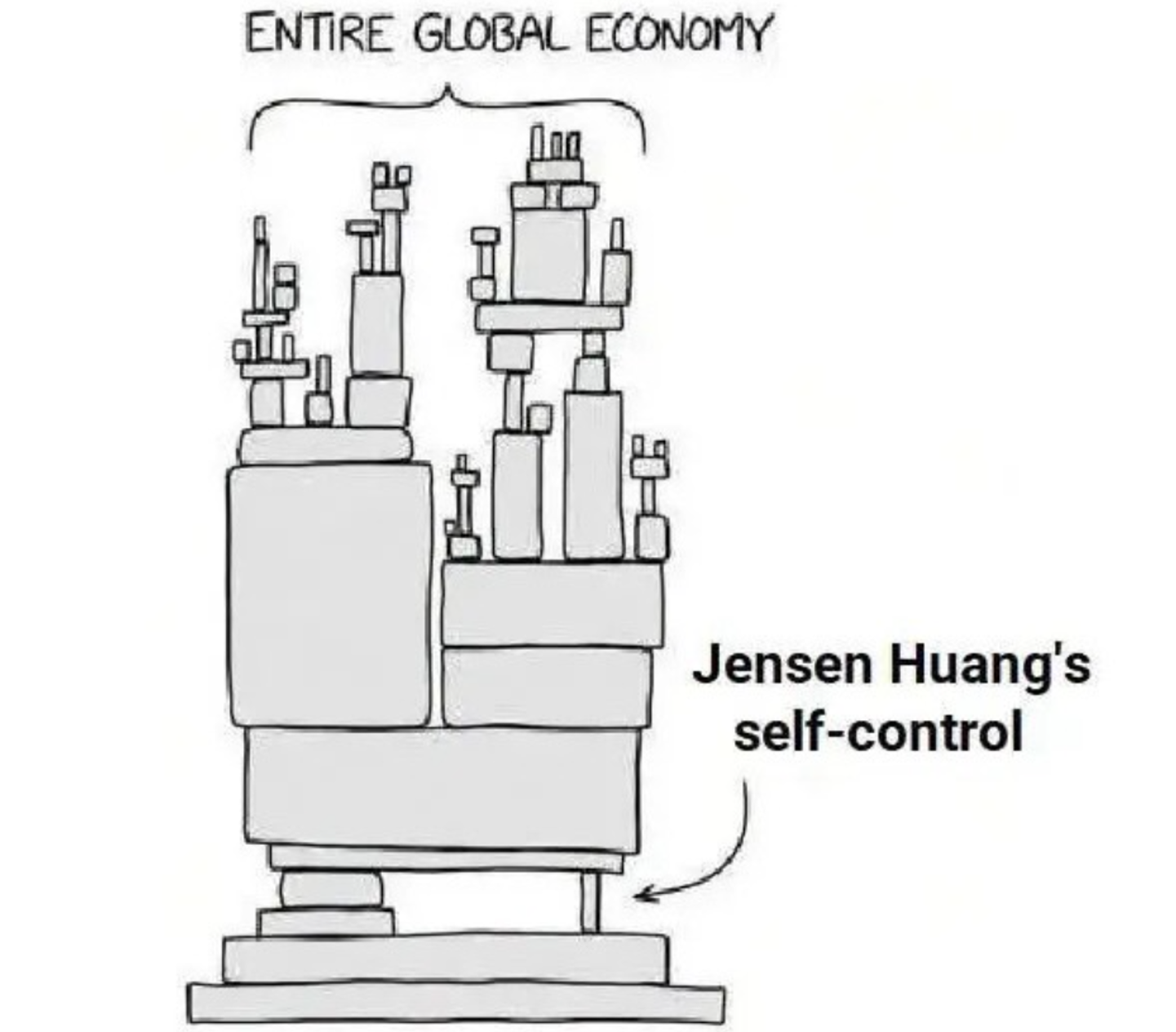
AI can be a truly revolutionary technology while the companies that enable it still face setbacks. Jensen Huang’s sudden departure from Nvidia is the latest reason to question the risks surrounding the AI boom, but it is actually not the most important one.
For investors in NVDA, the immediate concern is a sudden leadership change. Tighter restrictions on chip sales could add to the risk. Nvidia says its operations and product plans should continue uninterrupted.i
Investors should instead focus on whether AI businesses will earn enough to justify trillions of dollars in planned investment. The technology may improve productivity while competition pressures prices and profits. The next phase of AI investing should be focused on what investors are paying for the growth and profits that exposure ultimately produces.
Nvidia also helps finance customers building AI data centers. If its new leadership reduces that support, some customers could expand more slowly, affecting other suppliers and AI businesses.ii Such cuts are a possibility; no decision to make them has been announced.iii
This uncertainty brings a broader investment question into focus: will AI businesses earn enough to justify the money being committed?
Get our insights direct to your inbox: SUBSCRIBE
Better technology can mean lower profits
AI promises to help businesses produce more at a lower cost. Investors may assume that means higher profits. But what happens when competitors all get the same technology? A simple example shows why the answer matters.
Consider a town’s bakeries. Give one bakery an oven that makes twice as much bread at the same cost, and it gains an advantage over its rivals. Give every bakery that oven, and that advantage disappears. If they all double production, people aren’t twice as hungry. Unsold loaves pile up, bakeries cut prices, and profits can fall.
The ovens have delivered exactly what they promised. Customers get cheaper bread. Yet the bakery owners may earn less.
The same risk applies to AI. When competitors can use the same tools, competition can pass the savings to customers rather than leave them as extra profits for shareholders.
The reality is that higher productivity does not guarantee higher profits or higher margins.
AI could put software – and other firms’ profits – under pressure
AI can make useful software cheaper to build. Competitors may then offer similar products for less, or even for free.
An October 14, 2026, Futurism article reports that developers used Anthropic’s AI tool Claude to create free alternatives to Adobe products, including Photoshop, Lightroom and Premiere. It also reports that ArtCraft announced free alternatives to Microsoft Word, Excel and PowerPoint, called WordCraft, GridCraft and DeckCraft. ArtCraft charges for optional AI image and video services.iv
If free alternatives become good enough, established providers may have to cut prices or lose customers. That raises a serious question for businesses such as Adobe and Microsoft 365: how much will customers keep paying? The article does not show that the alternatives match every feature, that customers are switching in large numbers, or that profits have collapsed.
Examples beyond software show how AI can put profits under pressure:
- IFIS Japan: AI brought translation in-house; division operating profit fell 24.1% (Jan–Sep 2026).v
- Chegg: AI weakened paid-study demand; adjusted net profit fell 59% (Q2 2025).vi, vii
- Straker: AI squeezed translation prices; gross profit fell 18.8% (FY2026), amid other pressures.viii
- Reach: AI search hurt readership; adjusted operating profit fell about 4% (H1 2026); print also fell.ix, x
- Japanese translators: net profit fell 70.7% (FY2022–25) amid AI-driven price competition.xi
AI can be a spectacular success for its users without being a spectacular investment for its shareholders.
Projected AI spending exceeds past infrastructure booms
Pressure on profits matters when companies are committing enormous sums. The Wall Street Journal cites projected US investment of $10.3 trillion in data centers and related AI infrastructure from 2025 through 2032. Annual spending would average 3.63% of US economic output (GDP), above all the historical booms shown.xii
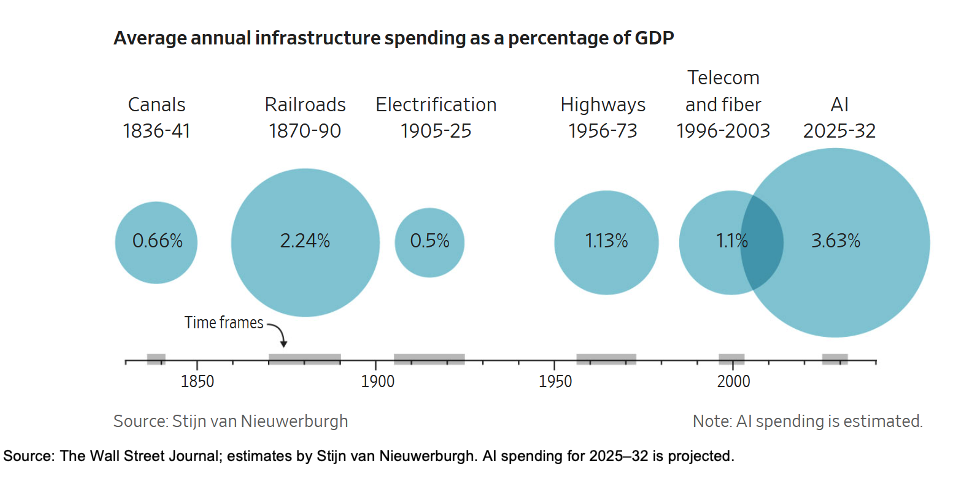
Source: The Wall Street Journal; estimates by Stijn van Nieuwerburgh. AI spending for 2025–32 is projected.
AI investment is rising unusually quickly
The Bank for International Settlements (BIS) compares how quickly investment grew during different booms. Spending by the major AI cloud companies reaches more than four times its starting level. The next biggest investment bubble, the canal boom, peaked after roughly five years. Paul Kedrosky describes the pace as “about half the time” of earlier booms. He argues that capacity is being built ahead of demand, putting future returns at risk.xiii
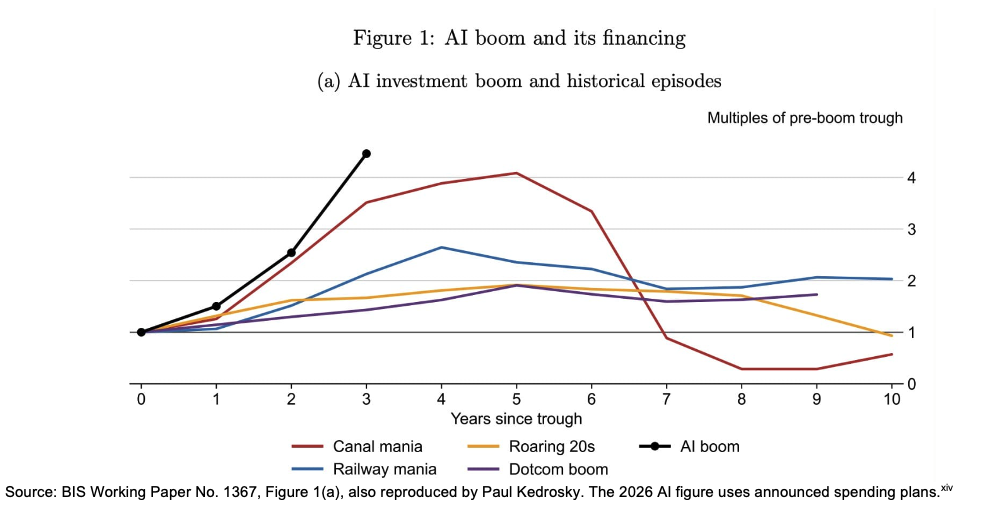
Source: BIS Working Paper No. 1367, Figure 1(a), also reproduced by Paul Kedrosky. The 2026 AI figure uses announced spending plans.xiv
Debt and shared funding can spread losses
A working paper from the BIS, which serves central banks, explains how this race could go wrong. Each company may spend heavily to avoid falling behind, even when the industry as a whole is building more than future revenue can justify.xv The paper’s full model puts early investment about 40% above the level it identifies as the best use of resources. A simpler version puts the excess at about 50%. These estimates depend on the model’s assumptions.xvi
If revenue disappoints, companies may stop expanding while still owing money on what they built. Selling specialized equipment at the same time can drive resale prices down and deepen losses.xvii Funding ties can spread the damage. A large technology company may invest in an AI developer that promises to rent its computing power. If the developer fails, its backer could lose money and cut support for another developer.xviii
These deals can fund useful projects while making the companies more dependent on one another.xix The paper does not predict an inevitable crash. Strong demand and productivity gains could justify substantial investment. Its warning is that useful technology can still be financed and built in ways that produce heavy investment losses.xx
L2 has a tool that can analyze any company’s exposure to AI in their business. If you would like to learn more, please reach out.
Disclaimer
The information, data, analyses, and opinions presented herein (a) do not constitute investment advice, (b) are provided solely for informational purposes and therefore are not, individually or collectively, an offer to buy or sell a security, (c) are not warranted to be correct, complete or accurate, and (d) are subject to change without notice. Kailash Capital Research, LLC and its affiliates (collectively, “KCR”) shall not be responsible for any trading decisions, damages, or other losses resulting from, or related to, the information, data, analyses or opinions or their use. The information herein may not be reproduced or retransmitted in any manner without the prior written consent of KCR. In preparing the information, data, analyses, and opinions presented herein, KCR has obtained data, statistics, and information from sources it believes to be reliable. KCR, however, does not perform an audit or seek independent verification of any of the data, statistics, and information it receives. KCR and its affiliates do not provide tax, legal, or accounting advice. This material has been prepared for informational purposes only and is not intended to provide, and should not be relied on for tax, legal, or accounting advice. You should consult your tax, legal, and accounting advisors before engaging in any transaction.
Nothing herein shall limit or restrict the right of affiliates of KCR to perform investment management or advisory services for any other persons or entities. Furthermore, nothing herein shall limit or restrict affiliates of KCR from buying, selling, or trading securities or other investments for their own accounts or for the accounts of their clients. Affiliates of KCR may at any time have, acquire, increase, decrease, or dispose of the securities or other investments referenced in this publication. KCR shall have no obligation to recommend securities or investments in this publication as a result of its affiliates’ investment activities for their own accounts or for the accounts of their clients.
© 2026 Kailash Capital Research, LLC – All rights reserved.
November 20, 2026 |
| Authors: Matthew Malgari, Nathan Przybylo, Dr. Sanjeev Bhojraj and John Durkin
November 20, 2026
Authors: Matthew Malgari, Nathan Przybylo, Dr. Sanjeev Bhojraj and John Durkin
