

What Can We Learn From Mr. Musk’s Track-Record?
In 2023, KCR noticed that Chamath Palihapitiya was invoking the “Man in the Arena” concept from Theodore Roosevelt’s spectacular Citizenship in a Republic speech given at the Sorbonne in 1910. We quickly unleashed our first-ever critique of any one individual in our 15 year history. His claim to being the “man in the arena” was an attempt to absolve himself of the carnage brought to those unfortunates who followed his investment deals, while he got rich off the transactions.
Get our insights direct to your inbox: SUBSCRIBE
As we noted at the lead-out of that piece “…rampant disinformation by promotional people has dire real-world consequence…[and KCR] found [Mr. Palihapitiya’s] self-styled analog [where he is somehow the hero despite his catastrophic investment results that decimated his investors while he got rich] typical of the intellectually shallow bro-culture grifters.”
In today’s piece, we briefly revisit Mr. Roosevelt’s speech. This time however, the application will be applied to Mr. Musk’s SpaceX, Tesla, and the associated promotional gibberish being used to prop up what we believe is one of the largest impending ponzi schemes investment disasters ever foisted on the American public.
In his 1910 speech at the Sorbonne, Theodore Roosevelt warned against admiring “the reward instead of the deed rewarded.” One of his sharpest critiques was directed at “the insincere man who to achieve power promises what by no possibility can be performed” — “not merely useless but noxious.” Of the salesman dressed as a benefactor, he was blunt: “if ever it becomes worth his while he will do something wrong against your interest.”
SpaceX is the modern test case, in our view. Now publicly traded at a roughly $2 trillion market capitalization, the stock prices in nearly 100x trailing sales on $18.67 billion of 2025 revenue, against $9 billion in cash losses.
To state the obvious, 100x sales is a valuation that is ten times higher than 10x sales. This matters because the track record of investing at 10x price to sales is well-documented as catastrophic. Most of that 100x sales multiple rests on a single forward-looking promise: that, post-xAI merger, SpaceX will put up to one million orbital data center satellites in low Earth orbit and undercut terrestrial hyperscalers within two to three years. Not one operational data-center payload is in orbit today.
The foundation of that promise is collapsing on the ground in Memphis. An internal memo from xAI president Michael Nicolls, obtained by Business Insider in May 2026, pegged Colossus 1’s Model FLOPs Utilization at just 11% across roughly 550,000 GPUs — “embarrassingly low” against an industry benchmark north of 40% — a failure Bloomberg attributes to a mixed Hopper/Blackwell cluster and latency between Colossus 1 and the two sites SpaceX tried to network it with. Unable to use the facility for frontier training, SpaceX has leased its entire 300 MW, ~220,000-GPU footprint to Anthropic, a direct Grok competitor, for $1.25 billion per month through May 2029 (with a 90-day cancellation right). The stopgap power keeping that under-utilized cluster running is itself contingent: 33 on-site gas turbines installed without the Title V permit the Clean Air Act requires, now under federal injunction (NAACP v. xAI, Case No. 3:26-cv-00074-MPM-JMV, N.D. Miss.).
The same organization that cannot achieve meaningful utilization on its own GPUs, cannot network its own data centers, and cannot lawfully energize the ones it has, is being valued on the premise that it will manufacture, launch, station-keep, and operate a million-satellite compute fleet within thirty-six months.
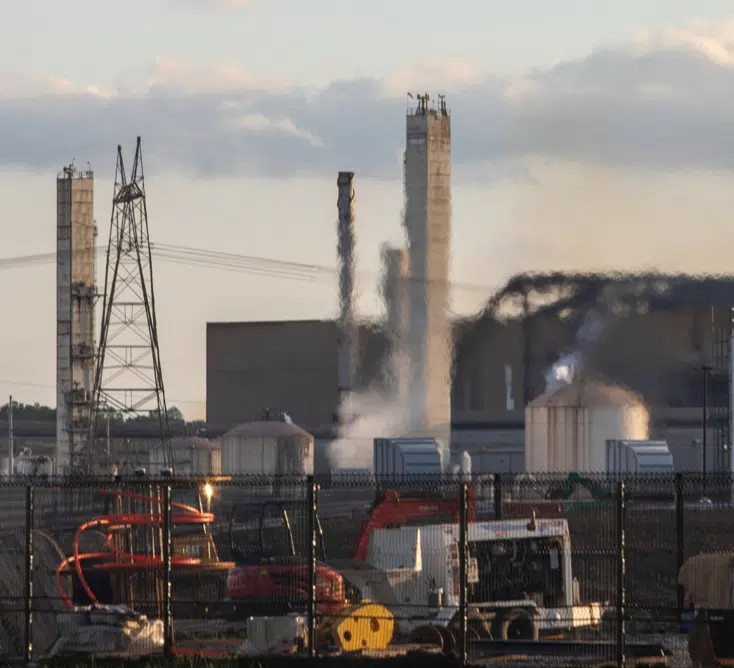 Photo: Stephen Voss / Redux Pictures, May 13, 2025 (via stephenvoss.com). Active emissions at the xAI Colossus site in South Memphis. The stopgap power configuration that keeps the underutilized 220,000-GPU cluster running depends on dozens of on-site methane gas turbines now operating under federal injunction in NAACP v. xAI — a fragile foundation for the orbital data-center pitch driving SpaceX’s post-merger ~$2T valuation.
The orbital data-center pitch is, in Roosevelt’s phrase, a promise that by no possibility can be performed on the timeline being sold, in our view. The scale of capital being raised against that promise is itself the tell. Bloomberg reported on June 18, 2026 that SpaceX is preparing a first bond deal of at least $20 billion on the heels of its IPO, with Oppenheimer’s Timothy Horan modeling more than $400 billion in net debt by 2031 — up from roughly $13 billion a few months earlier — supplemented by another ~$40 billion of equity. Goldman Sachs and Evercore ISI are modeling more than $1 trillion of cumulative SpaceX spend by 2030. Worse, annual capex is expected to potentially surpass $700 billion by 2031, the bulk earmarked for AI operations and the orbital data center vision. This is an enormous bet for a company that has not yet put a single data center satellite in orbit.
Since a vast amount of SpaceX’s valuation rests on the promises made by Mr. Musk, we thought it a worthwhile exercise to look at what we can learn about Mr. Musk’s track record using just the most recent Q1 earnings call for Tesla.
Below, we document Mr. Musk’s and Tesla executives’ most recent comments on the Q1 call vs. the associated promises. Using a single quarter’s commentary from just one of the enterprises Mr. Musk controls, the conclusion strikes us as both painful and obvious:


Disclaimer
The information, data, analyses, and opinions presented herein (a) do not constitute investment advice, (b) are provided solely for informational purposes and therefore are not, individually or collectively, an offer to buy or sell a security, (c) are not warranted to be correct, complete or accurate, and (d) are subject to change without notice. Kailash Capital Research, LLC and its affiliates (collectively, “KCR”) shall not be responsible for any trading decisions, damages, or other losses resulting from, or related to, the information, data, analyses or opinions or their use. The information herein may not be reproduced or retransmitted in any manner without the prior written consent of KCR. In preparing the information, data, analyses, and opinions presented herein, KCR has obtained data, statistics, and information from sources it believes to be reliable. KCR, however, does not perform an audit or seek independent verification of any of the data, statistics, and information it receives. KCR and its affiliates do not provide tax, legal, or accounting advice. This material has been prepared for informational purposes only and is not intended to provide, and should not be relied on for tax, legal, or accounting advice. You should consult your tax, legal, and accounting advisors before engaging in any transaction.
Nothing herein shall limit or restrict the right of affiliates of KCR to perform investment management or advisory services for any other persons or entities. Furthermore, nothing herein shall limit or restrict affiliates of KCR from buying, selling, or trading securities or other investments for their own accounts or for the accounts of their clients. Affiliates of KCR may at any time have, acquire, increase, decrease, or dispose of the securities or other investments referenced in this publication. KCR shall have no obligation to recommend securities or investments in this publication as a result of its affiliates’ investment activities for their own accounts or for the accounts of their clients.
© 2026 Kailash Capital Research, LLC – All rights reserved.
July 1, 2026 |
| Authors: Matthew Malgari, Nathan Przybylo, Dr. Sanjeev Bhojraj and John Durkin
July 1, 2026
Authors: Matthew Malgari, Nathan Przybylo, Dr. Sanjeev Bhojraj and John Durkin
