

The Quest for Causation in an Era with Only One Prior Precedent
Spurious vs. Specious: The Merriam-Webster dictionary tells us that despite both terms featuring deceptive or deceitful in their respective definitions, there is a surprising difference between “specious” and “spurious.”
Spurious, of “spurious correlation” fame, is explained as outwardly similar or corresponding to something without having genuine qualities.[1] Specious adds an element of appeal or allure.[2] More specifically:
“Specious indicates a superficial or deceptive attractiveness [while] spurious is [merely]… illegitimate. While we might use either word to modify argument, a spurious argument would be based on an illegitimate set of reasons, and a specious argument would be one that has an attractive appearance but is less plausible than it initially appears.”[3] -Merriam-Webster
Get our insights direct to your inbox: SUBSCRIBE
Let’s simplify the spurious vs. specious definition as follows: spurious arguments point to statistics that suggest strong relationships that don’t exist, while specious ones merely point to pretty pictures.
We bring this up to poke fun at one of our recent posts and the state of “analytical” affairs in the business of equity research. Our work has documented that the bubble, which crested at the end of 2021, featured some of the highest valuations, margins, and debt in nearly a century of American history.
Get our insights direct to your inbox: SUBSCRIBE
Lacking precedent, this has left many grasping at straws. KCR’s research team has been at this longer than we want to admit. We are used to seeing lots of spurious correlations, but the breaking of this bubble has given birth to an industry of specious research. Too often, there’s not even the pretense of causality.
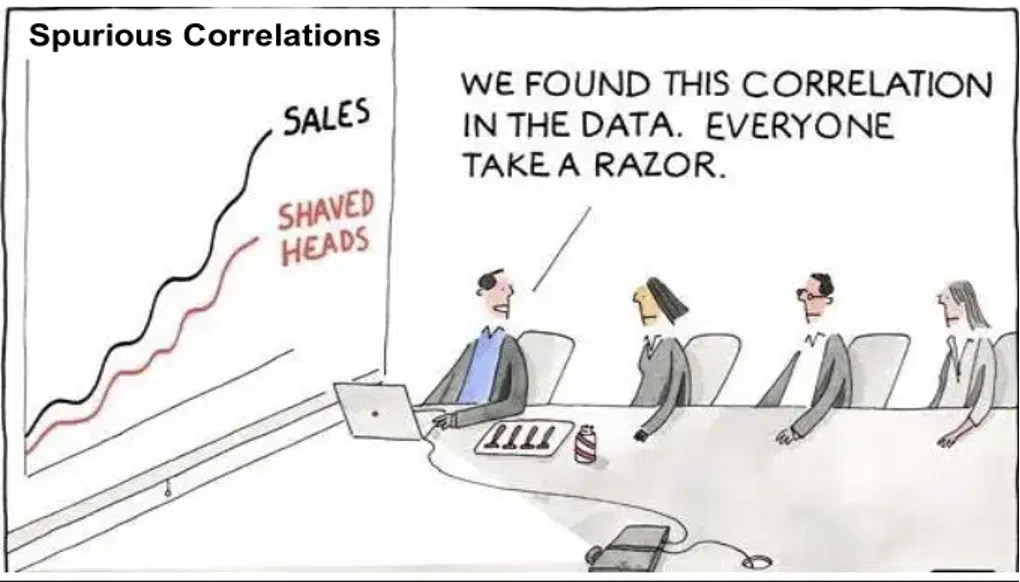 Source: http://bit.ly/3Yjy3EX
KCR’s recent missive ARKK vs. QQQ in the Dot.Com Bust represented an unusual post for our team. In an act of ruthless data mining and overfitting, we mapped ARKK’s decline today onto the decline of QQQs during the dot.com bust. This is most emphatically out of step with KCR’s evidence-based research process.
We were clear with our readers that the work was not a “trading call,” much less investment research of any kind. We have reproduced the chart as of publication below. What don’t you see us doing?

There’s no correlation coefficient on the chart. We avoided adding the correlation because the fit was awful, and even if the fit was high, we knew it would be a spurious correlation. The chart then was little more than specious in nature: it was an attractive picture that created the appearance of a relationship.
In our defense, we made the three following statements before suggesting people focus on fundamentals:
- Please do not misconstrue this as a trading call or investment advice of any kind.
- We have no idea if the post-dot.com precedent will repeat perfectly. History is a rhyming machine, not a repeating machine.
- The broader point we are making is that investors should not be surprised to see a package of low-quality novelty stocks gap higher.
Our point was that while history showed low-quality stocks may bounce around after bubble peaks, investors should focus on fundamentals as they “win” over the long run. And then it happened.


Disclaimer
The information, data, analyses, and opinions presented herein (a) do not constitute investment advice, (b) are provided solely for informational purposes and therefore are not, individually or collectively, an offer to buy or sell a security, (c) are not warranted to be correct, complete or accurate, and (d) are subject to change without notice. Kailash Capital Research, LLC and its affiliates (collectively, “Kailash Capital Research, LLC ”) shall not be responsible for any trading decisions, damages or other losses resulting from, or related to, the information, data, analyses or opinions or their use. The information herein may not be reproduced or retransmitted in any manner without the prior written consent of Kailash Capital Research, LLC . In preparing the information, data, analyses, and opinions presented herein, Kailash Capital Research, LLC has obtained data, statistics, and information from sources it believes to be reliable. Kailash Capital Research, LLC , however, does not perform an audit or seeks independent verification of any of the data, statistics, and information it receives. Kailash Capital Research, LLC and its affiliates do not provide tax, legal, or accounting advice. This material has been prepared for informational purposes only and is not intended to provide, and should not be relied on for tax, legal, or accounting advice. You should consult your tax, legal, and accounting advisors before engaging in any transaction. © 2021 Kailash Capital Research, LLC – All rights reserved.
Nothing herein shall limit or restrict the right of affiliates of Kailash Capital Research, LLC to perform investment management or advisory services for any other persons or entities. Furthermore, nothing herein shall limit or restrict affiliates of Kailash Capital Research, LLC from buying, selling or trading securities or other investments for their own accounts or for the accounts of their clients. Affiliates of Kailash Capital Research, LLC may at any time have, acquire, increase, decrease or dispose of the securities or other investments referenced in this publication. Kailash Capital Research, LLC shall have no obligation to recommend securities or investments in this publication as result of its affiliates’ investment activities for their own accounts or for the accounts of their clients.
February 10, 2023 |
| Authors: Matthew Malgari, Nathan Przybylo, Dr. Sanjeev Bhojraj and John Durkin
February 10, 2023
Authors: Matthew Malgari, Nathan Przybylo, Dr. Sanjeev Bhojraj and John Durkin
